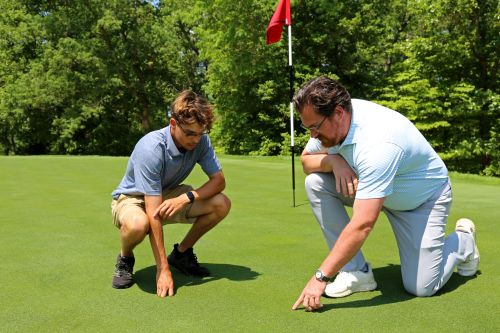
LIBERTY CORNER, N.J. (Feb. 23, 2026) – The United States Golf Association announced today the 2026 Greenkeeper Apprenticeship Program (GAP) class, marking the fourth year of the program. The 35 apprentices across both the Pinehurst and Myrtle Beach locations receive a combination of on-the-job training and classroom instruction, allowing the students to take their knowledge from the classroom directly to the course.
As part of USGA’s mission to advance the game, GAP was created to promote career growth and long-term success within the golf and turf industry. Through this program, students develop their skills at top-tier facilities such as Pinehurst Resort and Country Club, Tobacco Road Golf Club, The Dunes Golf and Beach Club, Bulls Bay Golf Club, and Southern Pines Golf Club.
Apprentices attend class at Sandhills Community College in Pinehurst, N.C., or Horry- Georgetown Technical College in Conway, S.C., where USGA agronomists, university scientists, industry professionals and golf course superintendents lead attendees through content anchored in the on-course experience gained during the program. The apprenticeship program has built strong momentum in its first three years. Across both sites, 68 participants have graduated, 27 have earned promotions (40 percent), and 64 remain employed in the industry (94 percent).
“GAP has been one of the more rewarding programs I’ve been lucky enough to experience in my time at the USGA,” said Matt Pringle, managing director of the USGA Green Section. “Addressing a critical need in the golf course maintenance industry, GAP is providing real opportunities for growth that previously didn’t exist, and we’ve seen some amazing success stories in just three years. Our program leads Carson Nesbella and Alan Owen have done a wonderful job of curating engaging lessons for the apprentices, which are being implemented on course and are having a real impact on career progression.”
Participants are employed full-time at a partner golf course facility in the Sandhills of North Carolina and the Grand Strand of South Carolina to build skillsets in turf management. Each apprentice receives support from leadership on site, a mentor and a field supervisor from the USGA to further their learning and provide a network of trusted associates to call on in the future. A variety of topics are covered throughout the year-long program, including water science, pest management, fertility and mathematics of turfgrass maintenance.
The 2026 GAP class consists of students from 14 states, 18 are aged 25 or under, and eight of the individuals are college graduates, including two with master’s degrees and one with a medical degree.
Among the 2026 class of GAP apprentices are:
- Rick Shannon, a 53-year-old from North Carolina, an active military member with a bachelor’s degree in criminal justice and a master’s degree in business administration.
- Haley Fox, a Colorado native with degrees in biology and exercise science, the daughter of a PGA professional and a golf course superintendent of more than 30 years.
- Nicholas Chace, who was born in Russia and moved from Massachusetts to join the program.
For a full list of the 2026 GAP participants, please see below.
|
Myrtle Beach Cohort |
Pinehurst Cohort |
||
|
Full Name |
Home State |
Full Name |
Home State |
|
Aidan Yeakey |
Georgia |
Benajamin Locklear |
North Carolina |
|
Andy Szczepkowski |
Georgia |
Bill Reda |
Illinois |
|
Clay Lentz |
South Carolina |
Brandon Shumate |
New Jersey |
|
Devin Thompkins |
South Carolina |
Brian Finley |
North Carolina |
|
Donald Graham |
South Carolina |
Dylan Mason |
Tennessee |
|
Haley Fox |
Colorado |
Ethan Ellis |
North Carolina |
|
Israel Chavez |
South Carolina |
Gabe Calloway |
Tennessee |
|
Jason Wright |
South Carolina |
George Page |
North Carolina |
|
Jeremy Headrick |
North Carolina |
Grayson Evatt |
Virginia |
|
Keenan Pritt |
Virginia |
Joshua Kiehle |
North Carolina |
|
Koby Cox |
California |
Landon Ring |
North Carolina |
|
Lylee Dziekan |
South Carolina |
Liam Dollard |
New York |
|
Nathan Fluellen Jr. |
South Carolina |
Mikey Remaley |
North Carolina |
|
Nicholas Chace |
Massachusetts |
Morgan Moree |
North Carolina |
|
Timothy Andrew Jacobs |
South Carolina |
Nicholas Hillard |
Pennsylvania |
|
William Davis |
New York |
Nicholas Solomon |
Michigan |
|
|
|
Rick Shannon |
North Carolina |
|
|
|
Sean Douglas |
Kentucky |
|
|
|
Thomas Welch |
South Carolina |
|
|
|
Zachery Waite |
Florida |
Since its pilot year in 2022, the success of those in the GAP program has already begun to address a critical need in the golf course industry at large – recruiting and retaining skilled labor on the maintenance staff. By creating these opportunities for apprentices, GAP is training the next generation of those who take care of golf courses, which also furthers the USGA Green Section’s mission of creating better turf for better golf at a lower cost to facilities. To learn more about GAP, click here.
In addition to GAP, the USGA has invested more than $75 million and supported multiple career development programs since 1991, including the P.J. Boatwright, Jr. Internship, Pathways Discover, Pathways Launch, and annual USGA internships. To learn more, visit the USGA's Careers webpage.
About the USGA:
The USGA is a mission-based golf organization whose purpose is to unify the golf community through handicapping and grassroots programs; to showcase the game’s best talent through the U.S. Open, U.S. Women’s Open Presented By Ally and 13 other national championships and our museum; to provide unbiased global governance with The R&A through the playing, equipment and Amateur Status rules; and to advance issues important to golf’s future, with a focus on driving sustainability, accessibility and inclusion. As a nonprofit association, our work and our team are driven to act for the good of the game. For more, visit usga.org.
About the USGA Green Section:
Since the founding of the Green Section in 1920, the USGA has led the effort to enhance golf course sustainability. Through research and services to courses that enable improved playing conditions, these efforts are aimed at reducing the consumption of critical resources such as water, chemicals, labor and energy. This mission is achieved through five primary programs – research, course consulting services, technology tools, championship agronomy and professional education and outreach. The USGA’s annual investment of $10 million in science, research, agronomy and course consulting efforts is estimated to provide more than $1.9 billion in savings to U.S. golf courses each year. These savings are realized through more efficient water, fuel, labor and nutrient management practices all while supporting improved playing conditions, for the good of the game.
Media Contact:
Reilly Romanko – RRomanko@USGA.org












© 2023 United States Golf Association. All Rights Reserved.